Saturday, 14 March 2009

Intrepid traveller... Catching up in Cairo

Ending a tour and farewelling the individuals with whom you've travelled - both the ones you liked and the ones you're giddy to see the back of - is the perfect time to reflect on the type of person you are. After four weeks missioning across the Middle East, it's confirmed: I'm temperamental.

I've been happy (riding a camel), sad (continually battling thieves), excited (diving the Red Sea) and petrified (squealing from the back seat when our 'Speed Racer' drivers rally raced across deserts). I've been patient with some locals and hissed at others (notably the ones who pinched my arse or were obviously picturing me naked); been blown away at the wonder of ancient ruins and bored stiff by others. Yes, I'm temperamental. But at least when I rest my head each night, I manage to see the funny side of life. And travelling in this region, you need to.

Sunrise as the moon sets on Sinai
Our group arrived in Cairo on Thursday afternoon, utterly sleep deprived, having left Dahab at midnight to start the climb of Mt Sinai at 2am. Neither of us religious, Boyfriend and I struggled emotionally and physically with the 6 kilometre hike. Rocky, dusty terrain, herds of smelly camels and their equally smelly Bedouin owners pimping their rides were just the beginning. My tired eyes bulged and the higher we climbed the colder it got until at the summit I lost feeling in my fingers and toes altogether. And even then it wasn't over. Having climbed for just under 3 hours we still had to wait an hour for sunrise - apparently a must-see in Egypt.

Must-see for some (at least 1,000 tourists, mostly senior citizens, joined us, while daily visitors average 3,000 during peak season), but jaded Christians that we are Boyfriend and I merely grumbled. After all, it's not even the 'real' Mt Sinai - that one's over in Saudi Arabia, along with Islam's Mecca - and the sun rises every day, doesn't it? Yes, I'm a totally ungrateful traveller.

After what seemed an eternity, the sun rose enough to warrent us to sigh, "Ahhh," and begin our trek back down the mountain. With the sun came the blazing heat, more grumbles and a dire need to pee. At the bottom I searched for a toilet only to be rudely shocked with a bowl full of used tampons and faeces, for which I paid ₤2 for the privilege.

From there our van drove westwards 8 hours - via the Suez Canal - into Cairo. From middle-of-nowhere to middle-of-mayhem, Cairo is one busy city. Full of dusty streets, falling down buildings next to half-built highrises and 18-odd million people, the city's one saving grace is its proximity to the pyramids.

With a local guide, on Friday, we saddled up camels and rode across the sand dunes until we were right up close. Finally something spectacular. More than four and a half thousand years old, the Great Pyramid of Giza is truly a world wonder. And while theories abound about the details of their construction, when you stand dwarfed by each pyramid's sheer size and magnificence, imagining near-naked, ancient workmen quarrying huge limestone bricks and piling them one by one, makes you appreciate just how easy life is now.

Like the millions before us, Boyfriend snapped me 'kissing' the Sphinx. We crawled into the sweaty depths of the Second Pyramid and even checked out Cheops' Solar Boat. Today we visited the Egyptian Museum to see Tutankhamun's gold bust and other tomb relics. Unsurprisingly the other 120,000 ancient Egyptian items on display are arranged in Arabic-disorder, most without labels and almost all without dates. Nearly two hours later we emerged into the sunshine, mummied-out and hungry.

Now we find ourselves preparing for our flight to Abu Dhabi. In the chaotic Khan el-Khalili Bazaar we bought a bigger carry-on bag to unload some of the weight from our checked baggage: sadly Etihad's limits severly restrict consummate consumers like myself. And in the land of the burkha, I doubt I can smile my way out of an extra 10 kilos!

Wednesday, 11 March 2009

Intrepid traveller... Diving Dahab

My cheeks are rosy, my shoulders bronzed and my skin has that tight, sun-dried, sandy feeling that you only get from beach exposure. Yes, I've finally found the sunshine. Happily, in Egypt.

Although interestingly enough, I spent most of the morning underneath the water. Having wanted to scuba dive for years but lacking both the funds and locale, Boyfriend and I signed up for an intro dive with Big Blue Dahab. We figured the Red Sea was as good a place as any to don wetsuit and fins and start breathing underwater. And while the concept isn't such a tough one, the reality was more of a challenge.

Squeezing into the micro sized wetsuit was the first hurdle. Thankfully I'm well practiced in jumping-like-a-moron-to-fit-into-skinny-jeans; Boyfriend struggled more so, initially putting his on inside-out-and-backwards.

And it wasn't like we'd not sat through 45-minutes worth of instruction - about equalizing water pressure on our eardrums, clearing water from our goggles while submerged, learning the relevant hand gestures and most importantly breathing in and out through our mouthpiece - but when it came to taking the plunge (pardon the pun), a huge part of my conscious mind started to panic. Just what the hell was I about to get myself into?

Our (amazingly patient and downright lovely) instructor, Ibrahim, waded me gently into the water - just off the shore - brought me to my knees and told me to breathe in deep: I did... and I still freaked.

As Boyfriend looked (laughed) on - clearly enjoying my plight - I mustered all my courage and told myself, "Pull yourself together and pretend this is Pilates." I did... and it worked.

But when we took to the water I had another dose of panic attack, having not quite fathomed the fact that we'd actually started our dive. Ibrahim had asked us to link arms and swim and I'd taken that to mean we'd 'practice' our swimming technique; as we began to delve deeper into the blue-black hole that was the sea I forgot my breathing, lost my serenity, threw Boyfriend off my arm and scrambled to the surface. Graciously the boys gave me another go. So down we all went to explore the wonder that is a live and vibrant coral reef.

I'd love to say that I took in every sparkling angel fish, every brilliant damsel and clownfish, all the wonderful coral clusters and the vast depths of the ocean, but I didn't. Sure I glimpsed them all - they were there in abundance - but as a first-time diver I spent the majority of the 46-minute dive breathing in, and breathing out; kicking from my hips and worrying that my ears weren't popping properly. Of course once it was over I wanted to dive again and again...

Just next time, I might meditate first.


Note: Pic thanks to Big Blue Dahab

Monday, 9 March 2009

Intrepid traveller... Jordan: In review

One week in the deserts of Jordan with no Net access and limited shower facilities has made me one smelly and anxious lady. Now in Aqaba - Jordan's seriously filthy seaport that borders Eilat, Israel, Boyfriend and I are counting the minutes (and our dinars) until we board our ferry to Egypt.

Not that we're under any delusion that Egypt will be less sandy or dirty, but our first destination is Dahab and our guide, Chloe, assures us that we'll be pleasantly surprised. We're taking that to mean that for the first time in a while our hotel bathroom won't smell like a urinal and that our bedsheets might just have been washed in between guests.

But I digress...

Not knowing much about Jordan other than it shares the Dead Sea with Israel and that it's the home of the wonderfully elegant Queen Rania, I had no preconceived ideas about what to expect. The capital city of Amman was much like Syria's Damascus only with better roads and infrastructure and it was there we met four new members of our group (two Irish sisters seeking some Jordanian sunshine, and an Aussie girl and English guy who will be with us right through to Cairo).

Our day trip to the Dead Sea was ludicrously expensive, and although the weather was great - just shy of 26 degrees - I failed to see the luxuriousness of bathing in a salty, oil slicked-bath. I stayed in long enough to pose for a photo then headed to the resort's chlorinated pools to take a dip in water nearing freezing point. We left two hours later all a little redder and dirtier than before.

Next stop was Petra. We bought a two-day pass, although I don't know why as neither Boyfriend or I are that into exploring old rocks and ruins... But we did the first day justice, covering a whopping 14 kilometres worth of the ancient Nebatean "rose-red city" (c.100 BC). We snapped the famous Treasury and hiked 45 minutes up to the ancient Monestary. And along with a thousand or so Thomson Cruise ship tourists - who'd been bussed-in for the day - we battled the blazing sun and the oppressive stench of donkey and camel urine. While the sheer size of the site can't help but be impressive, the litter everywhere and the pushy Bedouin salesmen (some as young as two years old) made the experience more of a challenge. Similarly, we found little beauty in watching donkeys being whipped across the mouth as they lugged lard-arsed tourists up the rocky cliffs. Petra certainly shows tourism at its worst.

From there we ventured further into the desert to stay a night in a 'traditional' Bedouin camp. A short safari jeep ride (to see some old rock inscriptions) and a mighty sandstorm later, we woke this morning ready to brace more sunshine. We've sand all through our bags (Australian customs is going to grill me for sure) and all our clothes are filthy...

What I wouldn't give right now for a flushing toilet and a real shower!

Note: Pic thanks to Sacred-Destinations.com

Wednesday, 4 March 2009

Intrepid traveller... Damascus

It's the early afternoon and I'm in a dusty internet cafe, cloaked in the smoke of a dozen Arab gentlemen all sitting around sipping tea. Boyfriend is tucked away in our hotel watching B-grade Hollywood movies having officially called it a day, in Damascus.

More mosques, more rubbled remains of 'great walls' and another grand bazaar... Damascus, our last stop in Syria, hasn't exactly wowed us. True, the ice cream rolled in pumpkin seeds served at Bakdash ice creamery in the Al Hamidiyeh Souq was lovely (if not a little gelatinous in texture) but apart from those, we're starting to see a sad trend of 'same-old, same-old' when it comes to Middle Eastern menus.

Usually a huge fan of kebabs, falafels and the like, Boyfriend today announced that if he has to eat one more falafel sandwich he'll dry reech. Just over halfway through our trip, I'm hoping he's exaggerating. Although I think his negative attitude has more to do with the fact we've had more money stolen - this time from my wallet which was inside our last hotel's safe...

At the rate we're hemorrhaging money I'm thankful at least our flights home our paid for!


Note: Bakdash ice cream pics thanks to Flickr.com

Monday, 2 March 2009

Intrepid traveller... Still wandering

We find ourselves amid a vast expanse of desert (only 230 kilometres from Syria's border with Iraq) in the ancient town of Palmyra (above). As I battle to blog via a dial-up connection let me reminisce our last few days.

En route from Aleppo to Hama - an important agricultural and industrial region of Syria - we passed the ruins of the Temple of Saint Simeon, a 5th century extremist-Christian monk who spent the last 36 years of his life living atop pillars (ranging from 9 to 60-feet high). In his quest for the meaning of life, and following a revelation he had in a dream, Simeon joined a monastery at 16 only to be dismissed for his extreme forms of penance (allegedly Simeon was a cutter). Seeking solace in the hills he went to live in a cave but when word spread of his devotion he soon found himself the object of pilgrimages. It was then he began to build pillars. Thanks to pilgrims and monks providing him with food and water via ladders, Simeon was able to live permanently mid-air. Why exactly he was made a saint is unclear, although the fact that he was reflects the favouritisms of the Christian church: Simeon taught that women were the spawn of the devil and refused for women to come anywhere near his pillars of solitude.

The Temple of St Simeon - the boulder representing the site of his first 9-foot-high pillar
Not exactly a hot spot for tourists, in Hama we were met with cautious smiles (revealing rotten gums and blue-black, bead-like teeth) and a good numbers of, "Well come"'s. Promoting tourism isn't big on the Syrian Government's agenda; however, Hama is considered a 'go to' place for locals to visit the 14th century water wheels (or norias) that border the Orontes river. Sadly the wheels weren't turning for our visit.

While revered by the townspeople, that doesn't stop them using it as their local dumping ground for waste. One woman begging on a bridge, with her crying toddler on her lap, casually threw a used diaper over the edge in between her wails of, "Baby. Money. Baby. Money." The build up of refuse has even caused a phenomenon I've termed, 'bubbling river' – first we thought raindrops were falling, but then we realised the bubbles were actually rising from below the green-murkiness. Lovely.

From Hama we bundled our group of four into the back of an old Merc (c.1955). The boot full to bursting we sat with bags on laps for the four hour drive to Palmyra, stopping just out of Hims for a guided tour of Crac des Chevaliers - one of the best preserved Crusader fortresses in the world. Only 30 kilometres from the border with Lebanon, Boyfriend was able to see the snow-capped mountains of his mother's ancestral homeland; although being as sentimental as a stone it required some coaxing on my behalf for him to eventually take a photo. As far as ruins go, Crac des Chevaliers is definitely one to see. Built in the early12th century by more than 1100 slaves over 75 years the result was a castle fit for fairytales. Heavily protected by two moat systems and innumerable holes in the ceilings and walls from which hot oil was supposedly poured over anyone attempting a break-in, the castle was never penetrated. Instead the Crusaders gave it up to the Islamic army in the late 13th century in return for safe passage out of the region.

Arriving into Palmyra in the late afternoon we were once again met by a semi-ghost town. Not ones for working excessively at the best of times, it would seem Syrian's take the words "off season" literally. Of the few shops open for business we had the options of dusty jewellery, carpets, remodeled Roman and Islamic helmets and shisha pipes for sale, and two run down restaurants. But according to The Lonely Planet, Palmyra is the place to see.

And to be fair, the ruins of the ancient city are fantastic. Set in a desert oasis and established in the 1st century, it was a prosperous city along the trade route linking Persia to the Mediterranean ports of Roman Syria. Having seen lots of (as Boyfriend calls them), "bundles of old rocks," on this trip we were surprised by the sheer size of the ruins and the enormity of the relics that have been restored. A trip at sunset to high hilltop where Palmyra's citadel still stands, gave us a wonderful panoramic view of the site. If only the new town were half as grand.

In the spirit of the Bedouins, tonight we ate a traditional underground-oven cooked dinner of chicken and rice in a carpeted tent amid the oasis. Suitably stuffed, we all agree that the food on offer in Syria has surpassed that of Turkey. Hummus, mattabal and tabuleh are provided in abundance, along with to-die-for falafel wraps sold by street vendors for a mere 20 cents (US). How strange it is to be in gastronomic heaven, amongst all this dust and debris.


Note: Top pic thanks to Flickr.com and St Simeon's boulder courtesy of Atlasttours.net.

Friday, 27 February 2009

Intrepid traveller... Searching Syria

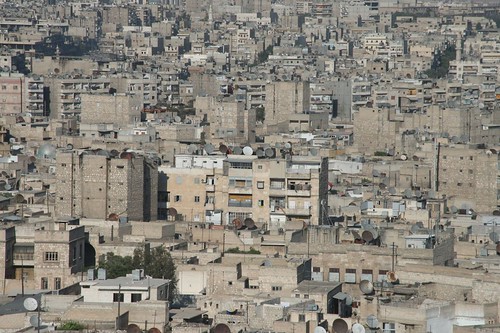
Syria is a land of contradictions. While the government heavily censors web access (Facebook is banned, as is Blogger but I've managed to break through via Mozilla Firefox) the streets around Aleppo - the country's second largest city - are littered with lingerie stores selling an array of neon coloured undergarments that would put Amsterdam's Red Light district to shame. Every house, flat or shop boasts a satellite dish - Aleppo from the air resembling a pock-marked teenager - with said-satellite television offering more than a hundred (graphic) Arabic porn channels. And yet of the few women seemingly granted 'street privileges,' all are covered from head to toe in floor-length overcoats and veiled burkas that shroud even their eyes from view. So just who is wearing the lime green knickers?

Crossing the border on Thursday - border control yet another example of Middle Eastern inefficiency where no fewer than six men are employed to do the work of one, as another half dozen look on smoking cigarettes and sipping tea - we spent the afternoon roaming through the souks. After buying a small child's weight in scarves, Boyfriend dragged me out of the musty, smelly mayhem (where lamb carcases hang in the open air next to stalls selling dried fruit, nuts and sweating cheeses) and back to our hotel.

On Friday, Islam's day of rest, we walked the deserted streets to the historic citadel. Aleppo is another city claiming the title of 'oldest inhabited city'; it's citadel a testament to the notion that at one time, the city was in fact quite grand. The hill, on which the ruins of a fortified medieval palace (c.1100 CE) now stand, is claimed to date back to the 3rd century BC. Sadly restoration of the site has slowed to a near standstill. The ruins reek of urine and the pathways and remains lay covered in people's rubbish. With most of the visitors local Syrians - we were among perhaps a handful of Westerners visiting with the masses - it's hard not to chastise the locals for their lack of pride in their great city's monument.

Looking out over the high limestone walls, across the great expanse of Aleppo - the city spanning 16,000 km² with a population just under 5 million - our 360 degree view was bleak. Searching for areas of vegetation left us wanting, with the only dots of green the patches of dying grass amid decaying buildings. It seems that repair and restoration is an unfamiliar concept to 'modern' Middle Easterners. Decrepit buildings are simply propped up with wooden sticks and new constructions are left incomplete to avoid paying the full amount of home owner tax. Even the 'grand' government building at the base of citadel hill had broken windows and debris spilling out into it's courtyard.

It baffles the mind as to how the same region that founded the civilised world, where impressive structures were built to stand the test of thousands of years, can now be so backward. Dust and dirt is everywhere and no one seems the least bit concerned. Travelling through India, Peru and even parts of South East Asia I found the same, poor people living amongst their own squalor. It costs nothing to pick up the rubbish strewn over your own balcony, roof top and outside your own front door - nothing except time; and time is certainly something the people seem to have in abundance.

Sorry, but my (independent/liberated/Western) female mind can't help but judge.


Note: Top pic courtesy of Bugbog.com, rooftops thanks to Flickr.com


Wednesday, 25 February 2009

Intrepid traveller... Rub-a-dub-dub

We're in Gaziantep, another of the supposedly 'oldest inhabited cities in the world,' and this morning I was scrubbed down by one of it's oldest residents.

At four-foot-nothing and wearing little more than a bra and shorts, my masseuse was otherwise the quintessential Turkish grandmother - albeit armed with a sanding mit, loofah and shampoo. For a country so consumed with covering up, the ladies working at Naib Hamami (Gaziantep's historic bath house built in 1640 at the base of the city's citadel) were all for stripping down.

Speaking no English, they shooed Chloe and I through to a marble changing room (complete with wooden cubicles and the odd Turkish rug), where we donned our bathers and flip flops, and led us by the hand through a doorway fit for hobbits and into the first of our washrooms.

I was sat on a metal stool as grannie doused me in hot water. She then scuttled me across to a large heated stone alter where I was made to lie down like Jesus on the cross, staring up at a ceiling spotted with star-shaped holes. This was apparently for 'quiet time' and to give our pores a chance to really open up... Chloe and I giggled continously enjoying the madness of our latest endeavour. After five minutes - and some static instructions in Turkish - my little lady brought me into the massage room.

The next 45 minutes were truly something. I lay on the marble floor, was scoured to burning point and rubbed and scrubbed in areas previously only visited by boyfriends and waxing ladies. When she straddled my recumbent body kneeding my breasts like dough I knew I was getting the Royal Treatment. Desperate not to start laughing I closed my eyes, but I couldn't quite get over the vigour with which this tiny person was scrubbing me up and down. The clumps of dead skin outlining my body the only reminder of what exactly I was there for.

After the scrub she took to my hair, emptying half the contents of a bottle of Pantene 2-in-1 onto my scalp; the other half she used on my body for the final rub down. Not once skerrick of my body was left uncleansed. I'd reached spa nirvana.

Not for faint hearted... more for those seeking a little bit of crazy: haman is undoubtedly my favourite Turkish experience.


Note: Top image courtesy of I feel it too, Naib Hamami thanks to www.suleymanucar.com

Monday, 23 February 2009

Intrepid traveller… Cappadocia

11 hours and 10 kilometres from our destination of Göreme, our overnight bus kicked us off at a small depot in the middle of nowhere, amongst yet more snow. Little explanation was given other than our bus was no longer travelling into Göreme – at a whim, the driver was heading straight to the next town.

Bag-laden we huddled together in the cold (offers for us to sit in the smoke filled reception room not-so-graciously declined) as we waited for the next coach to come along. It was 7am and the coach was due for 8am, Turkish-time. As we’ve come to realise the clocks in Turkey tick to their own beat, so our guide rang our hotel to see if they might collect us. Thankfully they were awake and answered her call.

Göreme is a small town in Cappadocia – a historical and unique area of Asia Minor known for its fairy chimneys (conical rock formations formed after volcanic eruptions more than 8 million years ago). Naturally porous and easily shaped, these conical hills became homes for the people of the area. Digging out the insides they were able to create cave dwellings that have stood for thousands of years.

Most of the cave houses have now been abandoned – their foundations finally crumbling – and those which are still occupied are owned by the government, leased to families and passed down the ancestral line. We were lucky enough to be invited into one such home yesterday, for tea and some soft-selling. On a walk through the town we bumped into Haditha, a local in her late fifties who moved to Göreme 28 years ago when she married her husband. It was his family home that she welcomed us into, showing off her 7-year-old granddaughter as well as her handmade scarves, etc. As nothing in Turkey is ‘for free’, Anna and Glen took one for the team and bought one of her handsewn pillow cases. Haditha told us it was real Zebra skin… although its leopard-like print made us question her translation.


Not ones for settling on simple caves above ground, the ancient people of the region also dug below, with more than 40 underground cities created from around 2,000 BC. These cave cities protected their inhabitants during war time, even housing livestock. We visited the biggest and deepest, Derinkuyu – with eight floors and extending to a depth of approximately 85 metres.

Tomorrow we continue to travel eastwards, to Gaziantep, on our way towards Syria.

Note: Sadly, my trusty Dell laptop (c.2003) has suffered a fatal blow – the connection to the main power supply no longer ‘connecting’ – so posts from now on will revert to using stolen photos from net (top pic thanks to Jim Shannon's photostream and Derinkuyu caves courtesy of Encounterturkey.com). I’m devastated; mainly because now I have to lug around 3-odd kilos of dead weight.

A darling addition...

Just past midnight on Saturday morning, as I lay cuddled-up to Boyfriend in our wood hut in Olympos, I woke - somewhat disorientated - to the sound of my mobile ringing. Before we left London I made sure to top up my credit, awaiting this phone call.


Sure enough it was news that my (middle) sister had given birth to a beautiful baby girl. A new sister for almost 3-year-old niece - and the fourth of my nieces - this little cherub enters a very female-focussed family. It will be a few years until I start a family of my own, but seeing my sisters with their babies only further endorses motherhood.

Only a few more weeks until I get to meet her (and her two-week old cousin) in person... My mission now: to find some gold, frankincense and mir for the little darlings.

Saturday, 21 February 2009

Intrepid traveller... Man make fire

We spent the night in Olympos, a small bungalow 'community' slightly off the beaten track. Once a great port town, established in the Hellenistic period, now it's kind of a tourist trap for those wanting to chill out on an isolated pebbled beach, smoke shisha and disappear for a while.

According to our itinerary, halfway up Mount Olympus (one of the twenty or so Mount Olympos' throughout the old Roman Empire) there are holes in the mountain that spontaneously ignite with flames: the area named Chimera after a mythical Greek fire breathing creature. Usually seen at night, Chloe suggested the 'legend' more impressive than the reality (apparently a thousand years ago ships could see the flames from the sea) so we skipped the 15 lira evening tour bus and instead chose to hike there this morning. We're taking our first overnight bus tonight so we were all keen for a bit of strenuous activity.

The sun shone brilliantly so the 12km walk was actually a pleasure - except for the part where we had to wade barefoot through a pebbled creek bed and sunk in quicksand.

But it was worth it. We climbed from the base up a good 800 metres and there in the clearing were a dozen or so open flames - like an abandoned campsite, although these barbeques have been burning for thousands of years.

While the flames were little, the boys were able to amuse both themselves and others by dousing the fires with water and reigniting them using various sticks and dried grasses they found. This activity wore on for a good hour or so before Chloe and I dragged them back down. Although the fact that two tour buses had arrived with others wanting to play with the flames helped our cause.

On the beach below Mount Olympus

The smile on Boyfriend's face was priceless. On the way home he even got to skim pebbles across the creek... fire and rocks made for one satisfied Homosapien.